top of page


Blood Donation
DONATION PROCESS
The donation process from the time you arrive center until the time you leave

1
Registration
You need to complete a very simple registration form. Which contains all required contact information to enter in the donation process.

2
Screening
A drop of blood from your finger will take for simple test to ensure that your blood iron levels are proper enough for donation process.

3
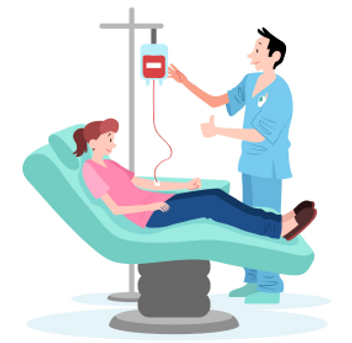
Donation
After ensuring and passed screening test successfully you will be directed to a donor bed for donation. It will take only 6-10 minutes.
_JPG.jpg)
4
Rest & Refresh
After blood donation, you’ll have to rest in the refreshment area. You’ll leave after 10-15 minutes and continue your normal routine. Suggested to more drink juice and water as well as some snacks.

Eligibility for Blood Donation
Blood donors should be in the age group of 18 to 65 years. Not less than 45 KG for whole blood and 50 KG for components.
Donor is not suffering from any major diseases like AIDS, Hepatitis-B and others
The systolic and diastolic blood pressures should be normal.
The hemoglobin of the donor should not be less than 12.5g/dl.
Donor should be free from Acute Respiratory Disease.
Temperature and Pulse should be normal.
Types of Blood Donation
Whole Blood Donation
-
What it is: The most common type of donation. You donate approximately 1 pint (about 470 mL) of blood.
-
Used for: Trauma patients, surgeries, and anemia.
-
Time: Takes about 8–10 minutes.
-
Donation frequency: Every 8 weeks (56 days).
Platelet Donation
-
What it is: A machine collects only platelets from your blood and returns the rest (plasma and red cells) to you.
-
Used for: Cancer patients, organ transplant recipients, and those with severe bleeding.
-
Time: Takes about 2–3 hours.
-
Donation frequency: Every 7 days, up to 24 times per year.
Plasma Donation
-
What it is: A machine separates plasma and returns red cells and platelets to you.
-
Used for: Patients with clotting disorders, burn victims, and shock treatment.
-
Time: Takes about 1 hour.
-
Donation frequency: Every 28 days, up to 13 times a year.


Blood type compatibility
You can take form
A+ A- O+ O-
You can give to
A+ AB+

Do’s And Don’ts To Follow Before And After Blood Donation
Before a day of Blood donation
-
Eat an iron-rich diet such as beans, spinach or meat, poultry.
-
Good sleep of 8+ hours.
-
Have more liquids in the food.
-
Be fully hydrated.
-
Avoid smoking
-
Avoid drinking
On day of Blood donation
-
Carry a valid identification e.g. Aadhar, Driving Licence, PAN.
-
Drink enough water before blood donation.
-
Have a healthy breakfast. Avoid fast food.
-
Wear a half sleeve shirt.
-
Provide a preferred arm or particular vein.
After the Blood Donation
-
Drink more liquids for next 24 hours.
-
Do not get immediately, rest at least 5 mins.
-
Eat well balanced meals for the next 24 hours.
-
Increase your fluid intake for the next 24 to 48 hours.
-
Do not smok

bottom of page